IN SOMALIA
Lack of
Contributing Factors
To start off, Somalia's history has not served them well in terms of other people and countries getting in their way. There are many assisting aspects that influenced the lack of education in Somalia, and one of them is the civil war. out setting in 1991, the civil war has, since then, torn the country apart. As a matter of fact, it is still going on now. Two decades later, not much improvement has been consummated. The ignition of the civil war was due to many militant groups such as Al-Shabab, Isaaq, Darod, and many more. After this, the country was divided and traumatized. All of these clans combined, and took over the government in 1991; Mohamed Siad Barre was the president of Somalia from 1969 until 1991. However, before all of this happened, where did all the education in Somalia come from?
The Somali education system was influenced by several cultures like the Arabs, Italians, and British. Indeed, even before these tribes interfered with the education, the Somali people had an informal way of education, in which the elderly transmitted social and cultural values to the young through examples and storytelling. But, in 700 A.D, the Arabs arrived. They had a significant part to play as they spread the most common religion all over the country, Islam. By 1300 A.D almost all Somali people converted to the religion. This completely changed the system of education from telling stories, to learning in schools and mosques. In 1300 A.D hundreds of Mosques and theological schools were built. In these buildings, the Arabic language, along with Quran was tought. This meant that everyone was provided with a free education, and this was the start of an era for Somali education. Students would use wooden slate to write on. The teachers were paid in the form of sheep, cattle, camels, and other food items.
Their knowledge intake remained stalemate until the eighteenth century when the British and Italians entered the archetype. When they reached Somalia, modernization hit their educational structure comprehensively. At the beginning of the new education, less than one percent of the population were enrolled, as it was expensive. This proved that the people did not favor colonial education. As years past, the U.N offered a trusteeship to provide public education for all Somalis. In the year 1960, 52 schools were built, with over 14,000 students enrolling. 1972 came the enormous transition for their education discipline. That year, Latin was changed to language that is to be learned in schools, and from 1972; all textbooks are changed, and teachers were trained so Latin could be taught.
Everything was advancing and developing well, until 1991, when education was halted by the initiation of the Somali civil war. It started when many groups overthrew the Barre government, which devised Somalia into many parts. Al-Shabab was the biggest power or force during this war. Al-Shabab was a group of 9,000 soldiers who are heavily armed. Their intentions were to spread fear and terror into the hearts of the Somali people, and in their attempt, they were successful. Some of their attacks were committed in places like Nairobi and Djibouti. The May 14 Attack in a restaurant in Djibouti, "The attack was carried out against the French Crusaders for their complicity in the massacres and persecution of our Muslim brothers in the Central African Republic and for their active role in training and equipping the apostate Djiboutian troops in Somalia," Al Shabaab said in a statement. Other than this, they have claimed responsibility for several bombings that have taken place over the course of this decade. They have continued to petrify the people of Somalia by forcing everyone to abide by their rules. Some of them include not watching televised sport, wearing a bra, or even listening to music. Al-Shabab has been known to track the export of many things like charcoal and untaxed sugar. They also stop the entrance of cease-fires from countries such as the U.S that provide aid to the Somali people. This was exemplified when U.S emergency airlifts brimming with food and crucial supplies were shot down by Somali rebels. After this, the American President at the time, George Bush, pulled out of his 1.7 billion dollar mission to support, bolster, and save this struggling country. In their first year of operation, 350,000 Somalis were killed, that is the kind of damage they undertook.
One year from the beginning of the war, Somalia was declared a failed state since there was no central government that would be autonomous. This gave Al Shabab and other militant groups the chance to get in control. War continued and many people had no choice but to leave the country. Somalia at the time did not have much resilience, so they did not know how to deal with the issue. Eventually, Kenyan troops entered Somalia in an attempt to fight Al Shabab along with the Somali military; and get them out of the major cities. This operation was specifically called Linda Nchi, which translates to, protect the country. By October 2011, many of Al Shabab's bases were exploited. Moreover, all militant groups were pushed out of the principle areas in Somalia, such as Mogadishu, the capital. Furthermore, in August 2012, the Somali Federal government was established; constituting the first permanent government since the civil war began. Later that year, things improved when Somalia was declared a fragile state, replacing its previous label of 'failed state'. A fragile state is a low-income country characterized by weak state capacity and/or weak state legitimacy leaving citizens vulnerable to a range of shocks. Al-Shabab has been kicked out of the preeminent areas, but still remain a potent threat to the rural towns. Finally, many citizens have returned from exile as a result of basic services returning.
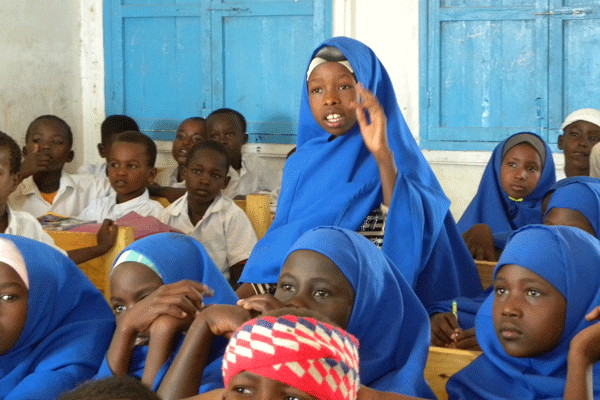
This war is an imperative influence on the lack of education because it stopped children from going to school. For many kids, their childhood has been embezzled from them. At the moment, agriculture is the most important economic sector in the country. Also, since several schools have opened since 2011, teachers have been hard to retain because of safety reasons. Moreover, salaries are unable to be paid by the government for the sake of low income.




History
